



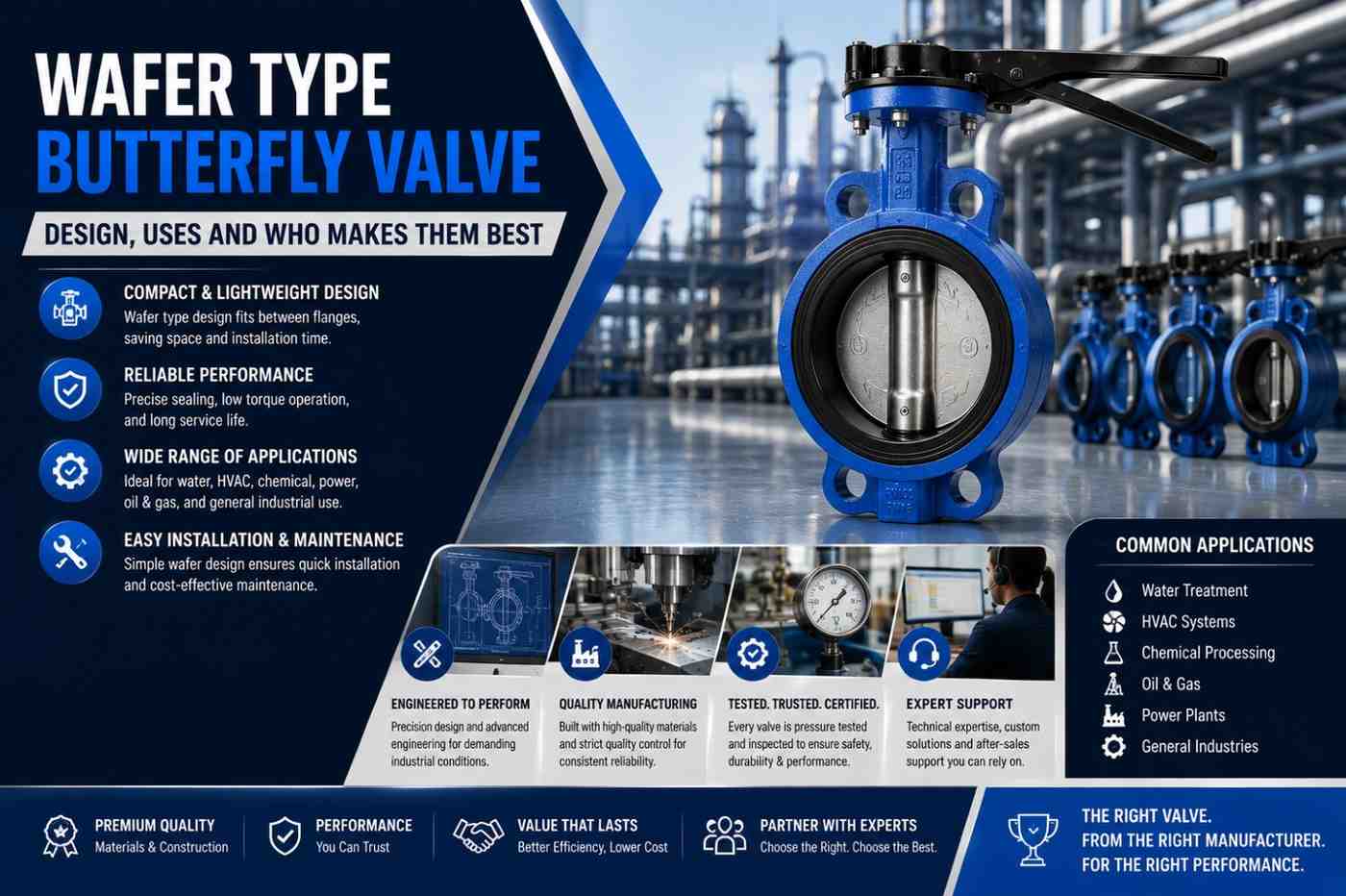


If you’ve spent any time around industrial piping systems, you’ve seen wafer type butterfly valves. They’re on cooling water headers. On fire water mains. On chemical feed lines. On HVAC systems in commercial buildings. In water treatment plants handling everything from raw intake to final distribution.
They’re probably the most widely used butterfly valve configuration in the world — and there’s a good reason for that. But “widely used” and “always correctly specified” are two different things. And the wafer type gets misapplied often enough that it’s worth going through what it actually is, what it’s good for, where it runs into problems, and what separates a well-made one from a cheap one that’ll give you trouble in six months.
What Makes It a “Wafer” Type
The name comes from how it fits into a pipeline. A wafer type butterfly valve doesn’t have its own flanges. Instead it sits — sandwiched, really — between two pipe flanges, held in place by bolts that pass through the pipe flanges and clamp the valve body between them.
This is the valve’s defining characteristic, and it’s what makes it compact and cost-effective. No heavy flanges on the valve body itself means less material, less weight, less cost. For large diameter applications — DN 200, DN 300, DN 400 and above — that weight and cost saving becomes significant enough that wafer type is the default choice for many engineers unless there’s a specific reason to go otherwise.
The disc sits on a stem that runs through the centre of the valve body, and when the valve opens, the disc rotates to allow flow. Standard wafer designs are concentric — the stem runs through the exact centre of the disc. More advanced double-eccentric designs offset the stem slightly, which reduces disc-to-seat contact during operation and extends service life, particularly at higher pressures.
Where Wafer Type Works Best
General water and utility service. Cooling water systems. HVAC. Fire water mains where the design code permits it. Chemical lines carrying mild to moderate fluids where the seat material is correctly matched. Large diameter low-pressure applications where gate or globe valves would be prohibitively expensive and heavy.
The wafer type butterfly valve handles all of these well. It’s compact, it’s easy to install (relative to heavier flanged valve alternatives), and in appropriate service conditions with the right seat material, it lasts. Flowjet Valves supplies wafer type butterfly valves across exactly these applications — from chemical plants in Gujarat’s industrial corridor to water treatment facilities and HVAC systems — and the product range in standard configurations covers DN 50 through to DN 600.
The key phrase in all of that is “appropriate service conditions.” And this is where wafer type butterfly valves get misapplied.
Where It Doesn’t Work — And Why Buyers Get This Wrong
Dead-end service. That’s the main one.
A wafer type butterfly valve relies on pipe flanges on both sides to stay in position. If you need to isolate a section of line and remove the downstream piping entirely — leaving the valve with pressure on one side and nothing on the other — a wafer type isn’t designed for that. The valve body will simply push out without the downstream flange holding it in place.
For dead-end service, you need a lug type butterfly valve, which has threaded inserts in the valve body that allow it to be bolted independently to each pipe flange. The wafer type gets installed here sometimes — usually by someone who assumed all butterfly valves work the same way — and the consequences range from an embarrassing leak to a more serious pressure release incident.
The other place wafer type butterfly valves get into trouble is when they’re specified for service conditions their seat material doesn’t suit. An EPDM-seated wafer type on a hydrocarbon line. A standard cast iron body on a line carrying concentrated acids. These failures are predictable. They happen because the valve type was specified correctly but the material combination wasn’t thought through.
A best butterfly valve manufacturer worth working with — and this is where Flowjet Valves earns its reputation in the Gujarat market — should be asking about service conditions before confirming a product recommendation, not just shipping whatever matches the size and pressure class in the enquiry.
What Separates a Well-Made Wafer Type From a Poor One
This is the question buyers don’t ask often enough, because wafer type butterfly valves look similar across a wide range of quality levels. The differences are mostly internal, and they only show up in service.
Seat retention and fit. The elastomeric seat in a wafer butterfly valve needs to be moulded or fitted to the body with enough precision that it seals properly against the disc on closure. A poorly fitted seat leaks. Or it seals initially and then shifts slightly in service. The machining tolerance of the body bore and the quality of the seat moulding both matter here.
Disc surface finish. The disc rotates against the seat every time the valve opens and closes. A rough disc surface accelerates seat wear. A disc with proper surface finish extends seat life significantly — important in applications where the valve cycles frequently.
Stem seal integrity. The stem passes through the body and is exposed to the process fluid at the seal. A poor stem seal leaks — sometimes immediately, sometimes after thermal cycling. For process applications, this is a safety concern, not just a maintenance annoyance.
Body concentricity. The disc needs to align correctly with the body bore for the valve to seat properly. Consistent machining of the body is what makes this reliable across a production batch. Inconsistent machining means some valves from the same order seat well and some don’t.
Flowjet Valves manufactures wafer type butterfly valves with in-house machining — which is the only way to actually control these variables rather than hoping they’re consistent across a batch of bought-in components.
The Material Question — Getting It Right the First Time
Standard wafer type butterfly valves from most manufacturers come in cast iron bodies with EPDM seats. That covers a large proportion of water and general service applications perfectly well.
But the moment your service conditions step outside that range — chemical compatibility concerns, elevated temperature, food or pharmaceutical hygiene requirements, higher pressures — you need a manufacturer who can offer alternatives. Ductile iron or stainless steel bodies. PTFE-lined bodies for chemical resistance. Viton or NBR seat options for specific chemical environments.
Flowjet Valves’ wafer type range covers the full material spectrum that Gujarat’s diverse process industries actually need — not just the standard configuration that covers the easy jobs.
Final Thought
The wafer type butterfly valve is a genuinely excellent product in the right application. The problem isn’t the design. It’s when it’s specified without thinking about whether the service conditions match what the design is built for — and without checking whether the manufacturer behind it actually controls the quality variables that determine how long it performs.
On both fronts, it’s worth asking more questions upfront. The valves that cause the least trouble are almost always the ones that were thought through most carefully before the purchase order was signed.