





Customer Relationship Management (CRM) systems have become an essential part of modern business operations. They help organizations centralize customer information, manage sales pipelines, improve communication, automate repetitive tasks, and deliver better customer experiences. However, implementing a CRM successfully involves much more than choosing software and installing it. Businesses must consider their processes, employees, data, integrations, security, and long-term objectives to ensure the system delivers measurable value.
For organizations investing in digital transformation, CRM implementation should also fit within their broader technology environment. Businesses exploring solutions such as Erp software in dubai need to consider how customer management, finance, operations, sales, and other business functions can work together. A well-planned CRM implementation can create a connected business environment, while poor planning can lead to low adoption, inaccurate data, operational disruption, and unnecessary costs.
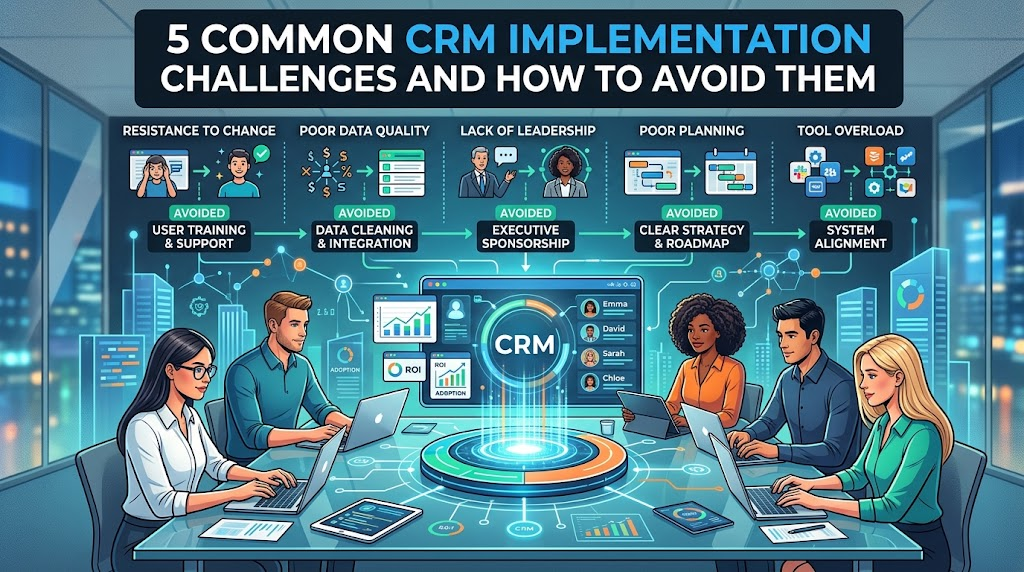
The good news is that most CRM implementation problems can be anticipated and addressed before they become major obstacles. Understanding the most common challenges allows businesses to create a more structured implementation strategy and achieve better results. Here are five major CRM implementation challenges and practical ways to avoid them.
1. Poor Planning and Unclear CRM Objectives
One of the most common CRM implementation challenges is beginning the project without clearly defining what the organization wants to achieve. Businesses sometimes select a CRM based primarily on its features rather than evaluating how those features support their actual business requirements.
For example, a sales department may want better lead management, while management may need improved forecasting and reporting. The customer service team may require a complete history of customer interactions, while marketing may want segmentation and automation capabilities. If these requirements are not identified before implementation, the CRM can become unnecessarily complicated and difficult for employees to use.
Effective CRM implementation begins with understanding existing business processes. Organizations should evaluate how leads are currently generated, how sales opportunities are managed, how customer information is stored, how customer service requests are handled, and where employees experience inefficiencies.
Clear objectives should then be established. Instead of having a general goal such as “improve sales,” a business could aim to reduce lead response times, increase conversion rates, improve customer retention, or reduce manual administrative work.
A detailed implementation roadmap also helps establish responsibilities, timelines, priorities, and measurable outcomes. When everyone understands what the CRM is expected to accomplish, the implementation becomes more focused and easier to manage.
2. Resistance to Change and Low User Adoption
Technology alone cannot make a CRM implementation successful. Employees must actually use the system correctly and consistently. Unfortunately, resistance to change is one of the biggest obstacles businesses encounter during CRM implementation.
Employees who have spent years working with spreadsheets, email, or legacy systems may be uncomfortable adopting a new platform. Some users may believe the CRM creates additional administrative work, while others may not understand how it benefits their daily responsibilities.
Low adoption can seriously reduce the value of a CRM. If sales representatives fail to update opportunities, customer service employees do not record interactions, or managers cannot rely on the information stored in the system, the organization will struggle to obtain accurate insights.
The solution is to involve employees from the beginning. Rather than introducing the CRM as a system imposed by management or the IT department, businesses should allow employees to participate in requirements gathering, workflow discussions, testing, and feedback.
Training also needs to focus on practical use rather than simply explaining software features. Employees should understand how the CRM helps them complete everyday tasks more efficiently. Sales teams, for example, should learn how the system can simplify lead tracking and follow-ups. Managers should understand how dashboards and reports can improve decision-making.
Ongoing communication is equally important. Employees need to understand why the organization is implementing the CRM, what will change, and how they will be supported during the transition. Strong change management can significantly improve user confidence and adoption.
3. Poor-Quality Data Migration
Data is at the heart of every CRM system. Customer names, contact details, communication histories, sales opportunities, purchase information, and other records provide the foundation for effective customer management. However, many organizations discover that their existing data is inconsistent, outdated, duplicated, or incomplete when preparing for CRM implementation.
Customer information may be spread across spreadsheets, email platforms, legacy CRM systems, accounting software, and other applications. Simply transferring all this information into a new CRM can move existing data problems into the new system.
Duplicate customer records are a particularly common issue. The same customer may appear under slightly different names, email addresses, or company information. Inaccurate records can then affect sales reporting, marketing campaigns, customer communication, and business decisions.
Data migration should therefore be treated as a major part of the CRM implementation process rather than a technical task that happens at the end.
Before migration, organizations should review their existing information and determine which records are accurate, relevant, and necessary. Duplicate information should be removed, outdated records should be reviewed, and inconsistent formats should be standardized.
Businesses should also define how data will be structured within the new CRM. This includes determining which fields are required, how customer records should be categorized, and which system will act as the primary source of information.
Testing is essential before completing the final migration. A sample dataset can be migrated first to identify errors and ensure that information appears correctly in the new CRM. Once the migration process has been validated, the organization can proceed with greater confidence.
Clean and reliable data improves CRM reporting, customer service, personalization, sales forecasting, and decision-making.
4. Complex Integration With Existing Business Systems
Modern businesses rarely operate with a single software application. CRM platforms often need to communicate with ERP systems, accounting software, marketing platforms, e-commerce websites, customer support tools, email systems, communication applications, and analytics platforms.
When these systems operate separately, employees may have to enter the same information multiple times. This creates unnecessary work and increases the risk of errors.
For example, when a sales opportunity becomes a customer, information may need to move from the CRM to finance, billing, inventory, or customer service systems. If employees have to manually transfer this information, the organization loses many of the efficiency benefits that CRM technology is supposed to provide.
CRM integration should therefore be considered before implementation rather than after the system has already been deployed.
Businesses should identify which systems need to communicate with the CRM, what information needs to be exchanged, and which application should act as the source of truth for each type of data. They should also determine whether information needs to be synchronized in real time or at scheduled intervals.
APIs, native integrations, middleware, and automation platforms can help connect different business applications. However, businesses should avoid creating unnecessary integrations simply because they are technically possible. Every integration should serve a clear business purpose and improve efficiency, data accuracy, visibility, or customer experience.
Proper integration planning can turn a CRM from an isolated application into an important component of the organization’s broader digital ecosystem.
5. Insufficient Training, Testing, and Post-Implementation Support
Another common CRM implementation mistake is treating the go-live date as the end of the project. In reality, successful CRM adoption continues long after the system becomes operational.
Without proper testing, businesses may discover problems with permissions, workflows, reports, integrations, automation, or data after employees have already started using the platform. These problems can disrupt operations and reduce user confidence.
User acceptance testing is therefore an important part of CRM implementation. Employees from different departments should test the system using realistic scenarios before launch. Sales representatives should test lead and opportunity management, customer service teams should test customer records and interactions, and managers should test dashboards and reporting.
Training should also be tailored to different user roles. Administrators require a deeper understanding of configuration and system management, while regular employees primarily need to understand the workflows and functions relevant to their responsibilities.
Post-launch support is equally important. Employees will naturally have questions when they begin using the CRM in real-world situations. Providing accessible support, documentation, refresher training, and regular feedback sessions can help organizations maintain adoption.
Businesses should also monitor CRM performance after implementation. User activity, data quality, workflow efficiency, reporting accuracy, and employee feedback can reveal areas that need improvement.
How Can Businesses Make CRM Implementation More Successful?
Successful CRM implementation requires a combination of technology, strategy, people, and processes. Businesses should begin by defining clear objectives and understanding their existing workflows. This allows the CRM to be configured around genuine business needs rather than forcing employees to adapt to unnecessary complexity.
Employee involvement should remain a priority throughout the project. Users who understand the purpose of the CRM and participate in the implementation process are more likely to adopt it successfully.
Data preparation should receive equal attention. A new CRM cannot produce reliable insights if it is filled with inaccurate or duplicated information. Businesses should clean, standardize, and validate their data before migration.
Integration planning is another critical factor. Connecting the CRM with relevant business systems can eliminate duplicate data entry and provide employees with more complete information. However, integrations should be carefully designed to avoid creating unnecessary technical complexity.
Finally, businesses should treat CRM implementation as an ongoing process. Customer expectations, business processes, and technology requirements change over time. Regular system reviews can help organizations improve workflows, introduce useful automation, and ensure the CRM continues to support business objectives.
Conclusion
CRM implementation can significantly improve customer management, sales productivity, business visibility, and operational efficiency, but choosing the right software is only the beginning. Poor planning, employee resistance, unreliable data, complex integrations, and insufficient training can prevent businesses from achieving the expected benefits.
The most effective approach is to treat CRM implementation as a business transformation initiative rather than simply a software deployment. By establishing clear objectives, involving employees, preparing high-quality data, planning integrations, testing workflows, and providing continuous support, businesses can build a CRM environment that is easier to adopt and more valuable over the long term.
For organizations seeking a broader approach to connecting customer management with business operations, ERP 360 can support a more integrated digital business environment where important processes and information work together more efficiently.
Frequently Asked Questions
What is the biggest challenge in CRM implementation?
User adoption is often one of the most significant CRM implementation challenges. Employees need to understand the value of the new system and receive appropriate training to use it consistently. Without adoption, even a technically successful CRM deployment may fail to deliver business value.
How long does CRM implementation take?
The timeline depends on the organization’s size, number of users, data volume, customization requirements, integrations, and business processes. A relatively simple CRM implementation may take several weeks, while a complex enterprise implementation can take several months.
Why is data migration important in CRM implementation?
Data migration transfers existing customer and business information into the new CRM. If the data is inaccurate, duplicated, or incomplete, these problems can affect CRM reporting, customer communication, sales processes, and decision-making. Cleaning and validating data before migration is therefore essential.
Should a CRM be integrated with an ERP system?
CRM-ERP integration can be highly valuable when sales, customer, finance, inventory, and operational information needs to flow between systems. Integration can reduce duplicate data entry, improve visibility, and create more consistent information across departments.
How can businesses measure CRM implementation success?
CRM success can be measured through improvements in sales conversion rates, customer retention, lead response times, employee productivity, data quality, customer service efficiency, and reporting accuracy. Organizations should define these measurements before implementation so they can evaluate performance after deployment.