

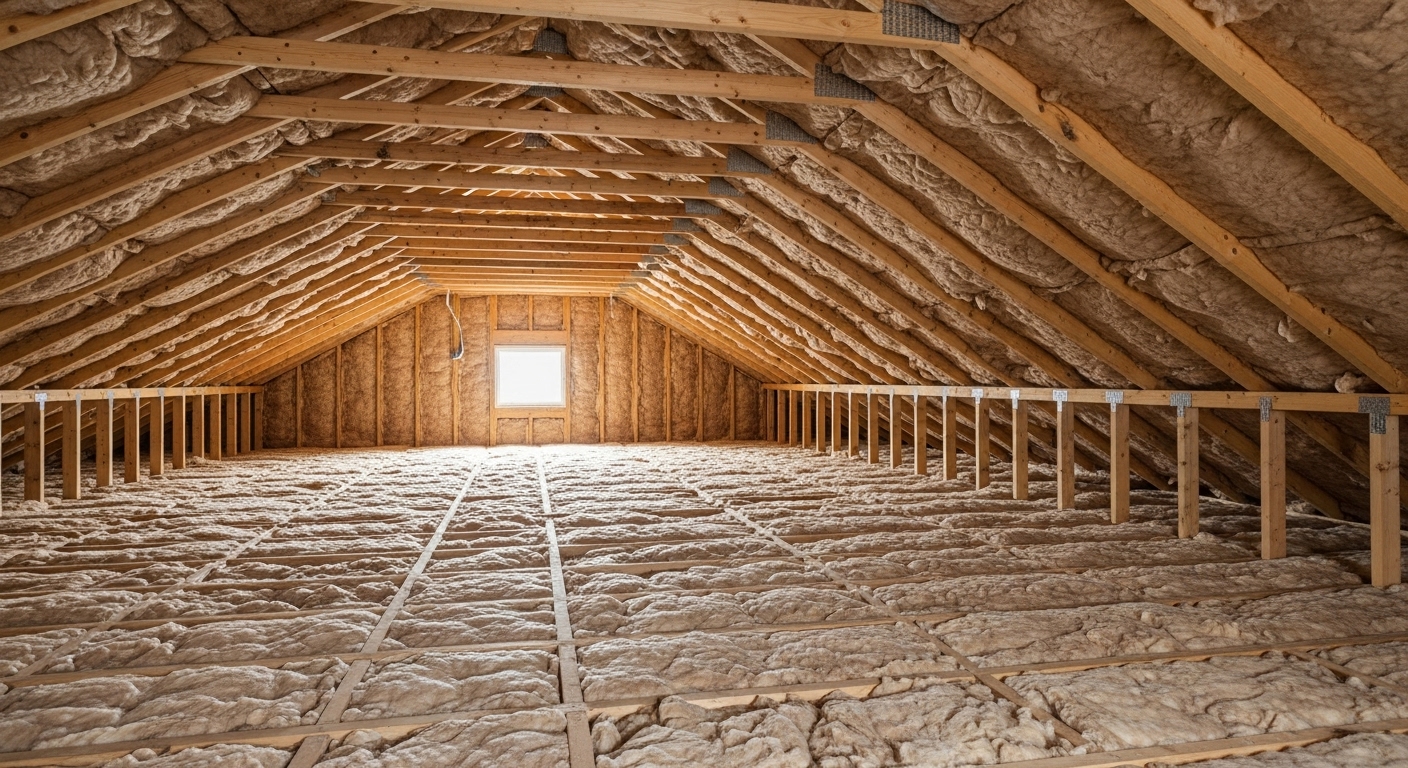




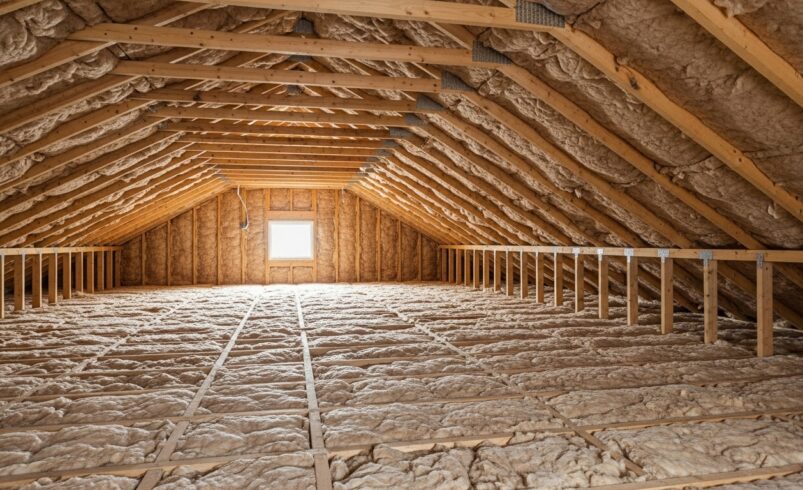

Most homeowners think insulation is simply about filling an attic with material and hoping for the best. In reality, the attic is one of the most critical control points of a home’s energy performance. A single miscalculation in insulation depth or coverage can quietly drain energy, reduce comfort, and shorten the life of the building itself. Studies in building science consistently show that a poorly insulated attic can be responsible for approximately 25–30% of total heat loss, making it a hidden but costly problem.
The most common assumption people have is the surface area when estimating. Nevertheless, estimation of attic insulation involves more analysis, such as depth, density, climate and airflow features. At the initial planning phases, the professionals frequently make use of a construction material takeoff to compute quantities, record insulation amounts in measurable information instead of assumptions. The approach is also accurate, consistent, and well documented without using product prejudice or marketing arguments.
You will know how the attic insulation may be estimated, what information should be taken into consideration, and how to estimate it with the result in the work of this guide.
What Does It Mean To Estimate Attic Insulation?
Estimating attic insulation involves computing the quantity of insulating material to be used in reaching the end objective on thermal performance. The process is concerned with coverage area, insulation depth and thermal resistance requirements.
The estimation is more about math, building science and measurement as opposed to choosing the materials. A precise estimation will aid in avoiding under-insulation which contributes to loss of energy. It, also, helps to avoid over-insulation that may cause ventilation and moisture problems. The aim remains non-biased, evidence based and performance oriented.
Reason Behind The Importance Of Accurate Attic Insulation Estimation
What is the correct estimation? The correct estimation will impact on the energy efficiency and comfort of the interior. Little insulation only permits the passage of heat through the attic. Excessive insulation may inhibit air movement and be a source of moisture.
Moreover, building codes tend to define minimum values of insulation. Making the right estimations will make one comply without making some changes in the future that are not necessary. To give an instance, cold climates generally would need more thermal resistance compared to warmer areas.
What Measurements Do You Need Before Estimating Attic Insulation?
How to Measure Attic Floor Area
Measure the horizontal area of the attic. The width and length can be used to get overall square footage. Premises always provide hard to see areas towards the eaves or storage platforms.
In case the attic is irregular in its shapes, subdivide it into rectangles.
It is important to add up the area of every section.Do not round off until the last calculations.
Calculation of Present Insulation Depth
Measure insulation depth that has already been applied now. Measure multiple points using a ruler to take into consideration the settlement irregularities. Take the minimum depth as a constant and not the maximum one.
This measure is significant due to the fact that current insulation leads to cumulative thermal resistance. Neglecting it may lead to poor estimates and discrepancy in performance.
The Impact Of R-Value On the Estimation of Insulation Of Attics
R-value is used in measuring heat resistance. The greater the R-values, the greater the insulating performance. The minimum R-values suggested in each of the climate zones are a product of energy research.
In estimating insulation in the attic, it is important to estimate how much is needed, rather than the additional material. Calculate the difference between the current R-value of insulation and the suggested value. The outcome dictates the level of further insulation.
How To Estimate Attic Insulation Thickness Step By Step
Step 1: Identify Target R-Value
The target R- value depends on climate, age of buildings and standards in a particular area.
Colder temperatures normally demand more values. Coverage is not necessary in warmer climates but may be helpful.
Step 2: Determine Depth Of Required Insulation
All types of insulations have their own R-value per inch. Divide the value of additional R required divided by the per-inch value. The value obtained provides the required inches of thickness.
Indicatively, when 20 more units of R-value are required, thickness will be determined by performance of insulation on a per-inch basis. This is the math that gives objective estimation devoid of product comparison.
Step 3: Multiply By Total Area
Divide overall square attic by thickness needed. The cost of this calculation gives the entire insulation volume. Insulation depth should be of cubic measurements when it varies.
The Effect Of Attic Design On Insulation Estimation
Flat Attics vs. Sloped Attics
The flat attics permit homogenous insulation depth. The sloped ceiling or cathedral shaped ceiling needs to be modified. Limitations of depth around eaves tend to decrease the thickness of insulation.
Tapering zones have to be taken into consideration in estimations in such cases. Three thermal weak points are caused by ignoring these areas.
Obstructions
Due to the presence of obstructions, the system might face increased vulnerability when subjected to potential attacks.<|human|>Obstructions and Penetrations: Because the system may be exposed to obstructions, it may become more vulnerable to susceptibility to potential attacks. Attics include vents, wiring, ducts, and framing.
Every obstruction minimizes the insulation space.
In the process of estimation, the total coverage is reduced by these areas. Heavy measurement prevents airflow obstruction and pressure.
How Air Sealing Impacts Insulation Estimation Accuracy
Insulation retards the flow of heat but does not prevent the flow of air. Insulation is affected by air leaks which lower the effectiveness of insulation.Penetrations occurring around the attic alter the actual performance.
In estimating insulations, you can take sealed and unsealed cases. This can be made up by deeper insulation in unsealed attics. With comprehensive insulation estimating, this change guarantees achievable performance expectations.
Common Mistakes When Estimating Attic Insulation
-
Determination of attic space through measurement of the attic under story.
-
Allowing disregard of depth of insulation.
-
Ignoring the need for ventilation clearance.
-
Average depth in place of minimum depth.
-
Not considering framing displacement.
Every error contributes to poor findings. These errors are avoided by careful measurements and documentation.
How To Adjust Estimates For Settling And Compression
Loose-fill insulation may be disturbed with time. Material behavior settling allowances have to be estimated. Even when it seems adequate, compressed insulation does not work.
Future settling also ensures future thermal performance. This step is a realistic building science and not an ideal condition.
Insulation of Attic: How Professionals Check Estimates
On the side of the experts, estimates are checked in the field by a comparison of measurements and calculations. They compare the theory to reality.
Thermal imaging can be used to verify uniformity of insulation even after installation. The estimation is done prior to the installation but the principles of validation enhance accuracy. It is performance-oriented, rather than being materialistic.
Conclusion
Surface measurements are not sufficient to learn how to estimate insulation of attics. It entails the knowledge of thermal resistance, depth, attic geometry and airflow issues. Proper estimation eliminates energy wastage, water problems, and performance problems in the long-term.
The insulation estimates can be reliable and repeatable by adhering to formal steps of measurement and using the principles of building science. It is a process that is not judgmental, is factual, and result-oriented instead of assumptions. Through correct estimation, the attic insulation planning process is not based on guesses but on an informed decision.
Frequently Asked Questions
What About The Insulation Of The Attic When The Joists In The Attic Are Not Even?
Lumpy joists cut across uniform insulation thickness in the attic.
Measure depth of insulation at various locations and take the lowest value of the average.
Then scale calculations so as to assure minimum necessary depth everywhere.
This technique eliminates thermal leaks.
Can Attic Insulation Estimation Change With Climate Conditions?
Yes, climate directly influences recommended R-values. Colder regions require higher thermal resistance levels. Estimations must align with climate-specific performance needs. Ignoring climate leads to inefficient insulation planning.