



Introduction
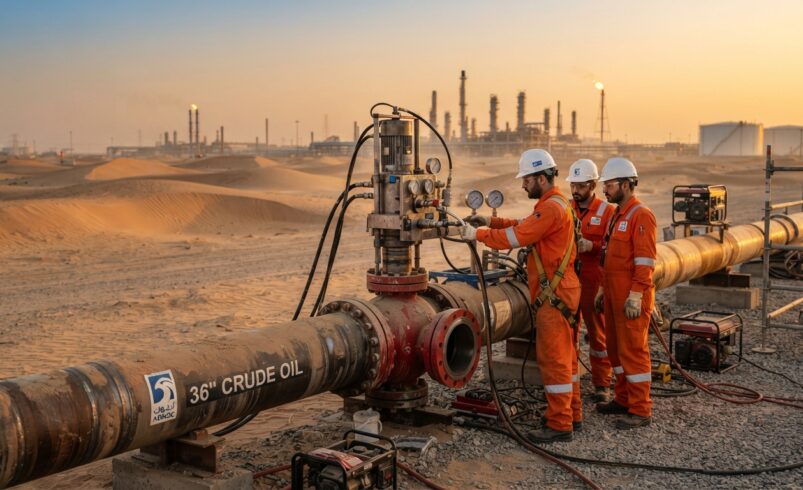
For pipeline operators, asset managers, and integrity engineers working across Abu Dhabi’s upstream and midstream sectors, hot tapping and line stopping services are among the most consequential technical operations performed on live infrastructure. They enable tie-ins, repairs, bypasses, and instrumentation additions without production loss — but they carry proportionally significant welding, integrity, and safety exposure that must be actively managed under recognised codes and standards.
This article addresses the technical decisions that separate a well-executed hot tapping and line stopping program from one that puts pipeline integrity at risk. It covers governing standards, welding-on-live-pipeline considerations, fitting and tool selection, isolation strategies, UAE-specific operational challenges, and contractor evaluation criteria.
The Role of Hot Tapping & Line Stopping in Modern Pipeline Operations
Across ADNOC’s onshore, offshore, and processing assets, hot tapping and line stopping services are the primary mechanism for maintaining production continuity during tie-ins and non-emergency repairs. Executed correctly, they eliminate the cost of shutdown, depressurisation, purging, and restart — a saving that on major crude and gas trunk lines can run into millions of dirhams per day.
Executed incorrectly, they introduce weld-related integrity threats, burn-through risk, coupon retention failures, and isolation breakdowns that can trigger release events, HSE reportables, and long-tail integrity liabilities. The difference lies in engineering rigor, standards compliance, and contractor capability — not in the tools themselves, which are broadly available across the market.
Governing Standards and Codes
Any hot tapping and line stopping operation in the UAE should be executed under a documented technical basis referencing recognised international standards:
- API 2201 — the primary industry standard for safe hot tapping practices in petroleum and petrochemical operations
- ASME PCC-2, Articles 2.10 and 2.11 — repair and hot tapping requirements for pressure equipment
- API 1104 — welding qualifications for pipelines and related facilities
- ASME B31.4 and B31.8 — governing design codes for liquid and gas pipeline systems
- NACE MR0175 / ISO 15156 — materials selection for sour service applications
- AGA / Battelle burn-through model — the industry-standard analytical basis for evaluating burn-through risk during in-service welding
Operator-specific specifications from ADNOC, TAQA, and ENOC layer additional requirements on top of these — particularly for hot work permits, welder qualification records, and third-party inspection.
Welding on Live Pipelines: The Critical Risk Factor
The dominant technical risk in any hot tapping operation is welding on a pressurised, flowing pipeline. Two failure modes govern the engineering assessment:
- Burn-through — where the pipe wall temperature at the internal surface exceeds the material’s ability to contain internal pressure. API 2201 recommends a minimum wall thickness of 6.4 mm (0.25 inch) for standard hot tap welding; thinner walls require Battelle model analysis and, often, specialist procedures.
- Weld cracking — particularly hydrogen-induced cracking (HIC) and sulphide stress cracking (SSC) in sour service. Low-hydrogen electrodes, controlled heat input, and adherence to NACE MR0175 hardness limits (typically 22 HRC on the HAZ) are non-negotiable.
The heat-sink effect of flowing product also complicates weld quality: high flow velocities cool the weld pool rapidly, requiring higher heat input than static conditions to avoid lack of fusion. Welder qualification specifically for in-service welding — not just general pipeline welding per API 1104 — is a meaningful differentiator between competent and incompetent contractors.
Fitting Selection and Design
Fitting selection is driven by pipeline diameter, wall thickness, pressure rating, service, and future functionality:
- Split-tees — the industry default for medium-to-large hot taps. Full 360° reinforcement, forged construction, and pressure ratings matching the parent pipeline.
- Weldolet-style fittings — used for smaller branch connections (typically ≤ 4-inch on larger mains), when full reinforcement is unnecessary.
- Mechanical bolt-on fittings — deployed where welding on the live line is not permissible due to service, wall thickness, or material limitations. Higher long-term integrity risk and typically restricted to specific service classes.
- Saddle fittings — reinforcement pads with a branch outlet, generally suitable for lower-pressure utility service.
Each fitting requires an installation Weld Procedure Specification (WPS) qualified under API 1104 for in-service welding, with Procedure Qualification Records (PQRs) that reflect the actual pipeline material, wall thickness, service, and flow conditions.
Line Stopping Technologies and Isolation Strategies
Line stopping tool selection depends on pipeline pressure, diameter, product, and the criticality of the isolation:
- Folding-head plugging tools (e.g., TDW STOPPLE™) — the industry standard for most medium-to-large stops. Available in single-stop and double-block-and-bleed configurations.
- Pivoting-head technologies — used where compact machine footprint or non-standard geometries are required.
- Double block and bleed (DB&B) configurations — two stops with a monitored bleed port between them, mandatory for hydrocarbon service where positive isolation must be demonstrable per ASME PCC-2 requirements.
- Completion technologies — lock-ring completion plugs (e.g., Lock-O-Ring™) provide a permanent, verifiable seal within the original fitting, avoiding a permanent welded cap in most standard applications.
For critical services — high-pressure gas trunk lines, sour service, offshore risers — DB&B is generally the default rather than an option. Single-stop configurations remain acceptable for lower-consequence services with adequate flare or vent contingency.
UAE-Specific Operational Challenges
Executing hot tapping and line stopping in Abu Dhabi introduces conditions not always addressed by generic international best practice:
- Sour service (H₂S) — Requires NACE MR0175-compliant fittings, controlled weld hardness, and often post-weld hardness verification.
- High ambient temperatures — Affects welder productivity, PPE selection, and equipment thermal ratings; extended weld cool-down times must be planned into the schedule.
- Offshore riser tapping — Requires topside coordination, tight lift plans, and often specialist rigging and habitat provisions.
- Aging onshore infrastructure — Legacy pipelines may lack accurate as-built wall thickness records; UT verification at the tap location becomes a prerequisite rather than an optional check.
- Coating systems — Coating removal and restoration around the fitting must comply with ADNOC coating specifications, particularly on export lines under cathodic protection.
Contractors familiar with these conditions absorb them into method statements; those unfamiliar surface them as scope changes and schedule delays.
Choosing a Contractor Partner
Executing hot tapping and line stopping services safely and efficiently requires an operational partner with more than tool ownership. Operators evaluating a pipeline contractor in Abu Dhabi should examine qualified welding procedures for in-service work, third-party HSE audit history, mobilisation record on ADNOC and TAQA assets, DB&B capability for critical isolations, and completion plug technology portfolio.
Equally important is engineering depth — the ability to perform burn-through analysis, review parent pipeline metallurgy, and issue technically defensible method statements — rather than a purely execution-focused capability. Contractors that own the full lifecycle from feasibility study through completion plug installation reduce interface risk and shorten project duration meaningfully.
Conclusion
Hot tapping and line stopping services are technically demanding operations that sit at the intersection of welding engineering, pipeline integrity management, and operational safety. For Abu Dhabi’s professional operators, the operational value comes from selecting fittings, procedures, and isolation strategies aligned with API 2201, ASME PCC-2, NACE MR0175, and operator-specific requirements — and executing them through contractors with demonstrable capability on comparable assets.
Handled well, these services deliver production continuity, cost efficiency, and integrity assurance. Handled poorly, they create weld defects, isolation failures, and long-tail liabilities that outlive the project by decades. The engineering rigor applied at the front end determines which outcome the operator gets.