

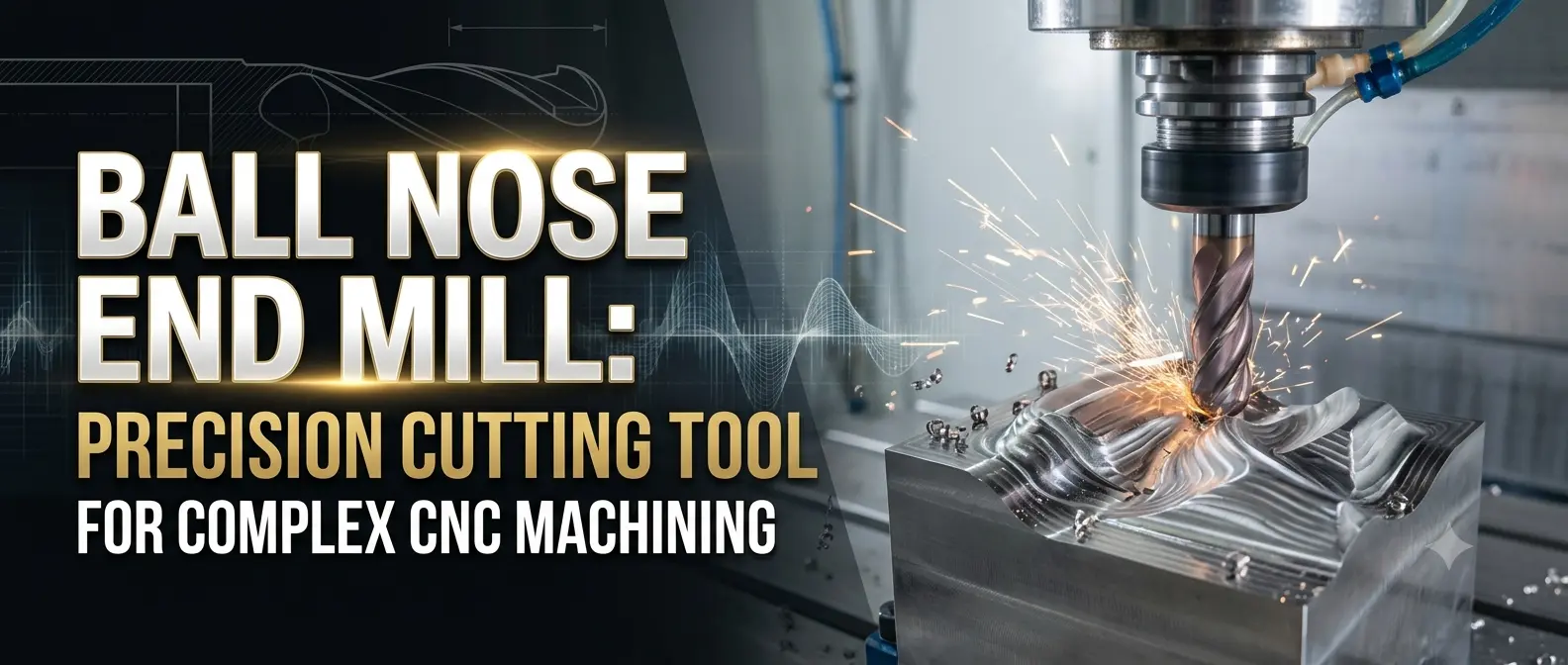




Modern CNC machining demands tools capable of producing intricate shapes, smooth surface finishes, and high dimensional accuracy. Among the most versatile cutting tools used across manufacturing industries is the ball nose end mill. Designed with a hemispherical cutting tip, this tool excels at machining curved surfaces, 3D contours, molds, dies, and complex geometries that standard flat end mills cannot efficiently produce.
Whether you’re working with hardened steel, stainless steel, aluminum, titanium, or composite materials, a high-quality ball nose end mill delivers exceptional precision, longer tool life, and improved machining performance. It has become an essential tool in industries such as aerospace, automotive, mold and die, medical device manufacturing, and precision engineering.
What Is a Ball Nose End Mill?
A ball nose end mill is a milling cutter with a rounded cutting end rather than a flat tip. This unique geometry allows the tool to create smooth, curved surfaces and intricate 3D profiles with exceptional accuracy.
Unlike square end mills, ball nose cutters are specifically designed for finishing operations, contour milling, and machining complex shapes where smooth transitions and superior surface quality are required.
Why Choose a Ball Nose End Mill?
Manufacturers rely on ball nose end mills because they provide outstanding flexibility and machining performance.
Excellent Surface Finish
The rounded cutting edge produces smoother finishes, reducing the need for additional polishing or finishing operations.
Ideal for 3D Machining
Ball nose end mills are widely used for machining molds, dies, prototypes, and freeform surfaces.
High Precision
Their design enables accurate contouring while maintaining tight dimensional tolerances.
Versatile Applications
These cutters perform well across a wide range of materials, making them suitable for multiple industries.
Applications of Ball Nose End Mills
A ball nose end mill is commonly used for:
-
3D contour milling
-
Mold and die machining
-
Engraving
-
Surface finishing
-
Profile milling
-
Radius machining
-
Aerospace components
-
Medical implants
-
Automotive parts
-
Precision engineering
Its versatility makes it one of the most valuable tools in modern CNC machining.
Industries That Use Ball Nose End Mills
Aerospace
Aircraft components often require complex curved surfaces and tight tolerances. Ball nose end mills provide the precision needed for machining lightweight alloys and heat-resistant materials.
Automotive
Manufacturers use these tools for machining engine components, molds, dies, and transmission parts.
Mold and Die Manufacturing
Creating intricate cavities and complex mold geometries requires the smooth cutting action of a ball nose end mill.
Medical Industry
Precision machining of surgical instruments, implants, and orthopedic components often relies on high-performance carbide ball nose cutters.
Benefits of Solid Carbide Ball Nose End Mills
Solid carbide remains the preferred material for premium cutting tools because of its excellent mechanical properties.
Advantages include:
-
Exceptional wear resistance
-
High cutting speeds
-
Excellent rigidity
-
Longer tool life
-
Superior heat resistance
-
Consistent machining accuracy
These qualities make carbide ball nose end mills ideal for demanding industrial applications.
Tool Coatings for Better Performance
Advanced coatings significantly improve machining performance.
Popular coatings include:
-
TiAlN (Titanium Aluminum Nitride)
-
AlTiN (Aluminum Titanium Nitride)
-
TiCN (Titanium Carbonitride)
-
DLC (Diamond-Like Carbon)
These coatings reduce friction, improve heat resistance, and extend tool life when machining difficult materials.
Choosing the Right Ball Nose End Mill
Selecting the correct cutter depends on several machining factors.
Consider:
-
Workpiece material
-
Tool diameter
-
Number of flutes
-
Cutting depth
-
Surface finish requirements
-
Machine spindle speed
-
Coolant availability
Choosing the proper tool ensures better productivity and consistent machining quality.
CNC Materials Suitable for Ball Nose End Mills
Ball nose end mills perform effectively on:
-
Carbon steel
-
Stainless steel
-
Tool steel
-
Hardened steel
-
Aluminum alloys
-
Copper
-
Brass
-
Titanium
-
Nickel alloys
-
Plastics
-
Composite materials
Selecting the correct grade and coating helps maximize tool performance.
Best Practices for Using Ball Nose End Mills
To achieve optimal machining results:
-
Use recommended cutting speeds.
-
Maintain proper feed rates.
-
Minimize tool overhang.
-
Apply suitable coolant where required.
-
Choose appropriate step-over values.
-
Secure the workpiece firmly.
-
Inspect the tool regularly for wear.
Following these practices improves machining accuracy and extends tool life.
Why Carbide Ball Nose End Mills Improve Productivity
High-performance carbide tools allow manufacturers to:
-
Reduce machining time
-
Improve surface finish
-
Increase production efficiency
-
Lower tooling costs
-
Reduce vibration
-
Enhance dimensional accuracy
-
Minimize secondary finishing operations
These advantages contribute to higher-quality finished components and more efficient manufacturing processes.
Why Choose Solarys Carbide?
Solarys Carbide manufactures premium ball nose end mill solutions engineered for precision CNC machining. Using high-quality solid carbide, advanced grinding technology, and strict quality control, the company produces cutting tools that deliver exceptional accuracy, durability, and long service life. Their tooling solutions support industries including aerospace, automotive, mold and die, medical manufacturing, and general engineering with reliable, high-performance machining solutions.
Final Thoughts
A ball nose end mill is an indispensable cutting tool for manufacturers requiring precision, smooth surface finishes, and complex 3D machining capabilities. Whether producing molds, aerospace components, medical devices, or precision mechanical parts, investing in high-quality carbide ball nose end mills improves productivity, enhances machining accuracy, and reduces production costs.
By selecting the right tool geometry, carbide grade, and coating, manufacturers can maximize CNC machining performance while achieving outstanding results across a wide range of industrial applications.